
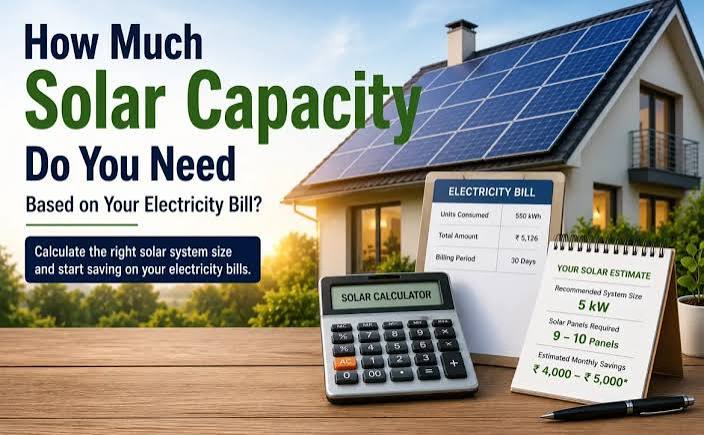
Installing a rooftop solar system is a smart investment—but only if you choose the right size. A system that’s too small may not generate enough electricity to meet your household’s needs, while an oversized system can increase your upfront costs without delivering proportional benefits.
So, how do you determine the ideal solar panel capacity for your home? This guide explains the process step by step.
Step 1: Check Your Monthly Electricity Consumption
The easiest way to estimate the right solar system size is by reviewing your recent electricity bills.
Look for your monthly electricity consumption, measured in units (kWh).
For greater accuracy, calculate the average consumption over the last 6–12 months, as electricity usage often changes with the seasons.
Step 2: Understand Your Daily Electricity Usage
Divide your average monthly consumption by 30 to estimate your daily electricity requirement.
Example:
| Monthly Consumption | Daily Average |
|---|---|
| 300 units | 10 units/day |
| 450 units | 15 units/day |
| 600 units | 20 units/day |
This gives you a good starting point for sizing your solar system.
Step 3: Estimate the Required Solar Capacity
In many parts of India, 1 kW of rooftop solar can generate approximately 4–5 units of electricity per day, depending on sunlight, weather, roof orientation, and system efficiency.
Using this estimate:
| Daily Electricity Need | Suggested Solar Capacity |
|---|---|
| 4–5 units | 1 kW |
| 8–10 units | 2 kW |
| 12–15 units | 3 kW |
| 16–20 units | 4–5 kW |
These are general estimates. Actual requirements vary based on local conditions.
Step 4: Consider Future Electricity Needs
Think about how your electricity usage may change over the next several years.
You might need additional capacity if you plan to:
- Buy an electric vehicle (EV)
- Install more air conditioners
- Add new household appliances
- Expand your home
- Increase family size
- Work from home more frequently
Planning ahead can help avoid costly upgrades later.
Step 5: Check Your Available Roof Space
The available rooftop area also affects the system size you can install.
Approximate space requirements:
| Solar System Size | Estimated Roof Area Needed |
|---|---|
| 1 kW | 80–100 sq. ft. |
| 2 kW | 160–200 sq. ft. |
| 3 kW | 240–300 sq. ft. |
| 5 kW | 400–500 sq. ft. |
Actual space requirements depend on panel efficiency, mounting structure, and roof layout.
Step 6: Consider Your Budget
Larger systems generate more electricity but also cost more.
Factors affecting the total investment include:
- System size
- Solar panel quality
- Inverter type
- Installation complexity
- Roof structure
- Government subsidy eligibility
Choose a system that balances your energy needs with your budget.
Step 7: Account for Government Subsidies
Eligible homeowners may receive financial assistance under the PM Surya Ghar: Muft Bijli Yojana for residential rooftop solar installations.
The subsidy can significantly reduce the upfront installation cost, making larger systems more affordable for many households.
Step 8: Get a Professional Site Assessment
Before making a final decision, request a site survey from an experienced installer.
They will evaluate:
- Roof orientation
- Tilt angle
- Shading from nearby buildings or trees
- Structural strength
- Electrical infrastructure
- Local regulations
A professional assessment ensures the system is designed for optimal performance.
Example Calculation
Suppose your family uses 360 units of electricity each month.
- Daily consumption = 360 ÷ 30 = 12 units
- A 3kW rooftop solar system typically generates around 12–15 units per day under favorable conditions.
In this example, a 3kW system may be an appropriate choice, although the final recommendation should be based on a site assessment and local conditions.
Common Mistakes to Avoid
- Choosing the cheapest system without considering quality.
- Ignoring future electricity needs.
- Not checking roof space before purchasing.
- Installing a system without a professional site survey.
- Selecting a larger system than permitted under local regulations.
- Overlooking warranty and after-sales service.
Conclusion
Choosing the right solar panel capacity is one of the most important decisions when installing a rooftop solar system. By analyzing your electricity bills, estimating daily energy usage, evaluating roof space, planning for future needs, and consulting a qualified installer, you can select a system that delivers reliable performance and long-term savings. A well-sized solar installation not only reduces electricity bills but also maximizes the return on your investment.
Frequently Asked Questions (FAQs)
1. How do I know what size solar system my home needs?
The best starting point is your average monthly electricity consumption. Your roof space, future energy needs, local sunlight conditions, and budget should also be considered before selecting a system.
2. Is a 3kW solar system enough for a typical family?
A 3kW system is generally suitable for households consuming approximately 250–450 units of electricity per month, though actual suitability depends on your specific usage.
3. How much roof space is required for rooftop solar?
As a general guideline, you may need approximately 80–100 square feet per kW, depending on the type and efficiency of the solar panels.
4. Can I install a larger system for future electricity needs?
Yes. If you expect your electricity consumption to increase, such as after purchasing an electric vehicle or adding new appliances, you may consider a larger system if your roof space and local regulations allow.
5. Will government subsidies help reduce installation costs?
Yes. Eligible residential consumers can receive financial assistance under the PM Surya Ghar: Muft Bijli Yojana, subject to current government guidelines.
6. Do I need batteries with my rooftop solar system?
Not necessarily. Many grid-connected rooftop solar systems operate without batteries and use net metering or another approved export arrangement, depending on local regulations.
7. Can shading affect my solar system’s performance?
Yes. Trees, neighboring buildings, chimneys, and other obstructions that cast shadows on the panels can reduce electricity generation.
8. Should I rely only on online solar calculators?
Online calculators provide useful estimates, but a professional site assessment is recommended to determine the most suitable system size for your home.
9. How long does it take to install a residential rooftop solar system?
Installation timelines vary depending on approvals, system size, site conditions, and your DISCOM’s procedures. The physical installation itself is often completed within a few days once approvals are in place.
10. What happens if my electricity usage changes after installation?
If your electricity needs increase significantly, you may be able to expand your system, subject to available roof space, equipment compatibility, and local regulations.
Disclaimer: The figures and recommendations in this article are illustrative estimates. Actual system capacity, electricity generation, installation costs, subsidy amounts, roof space requirements, and financial savings depend on your location, roof conditions, equipment quality, electricity consumption, weather, and applicable government policies. Consult an authorized solar installer and your local DISCOM before making a final decision.
Leave a Reply