
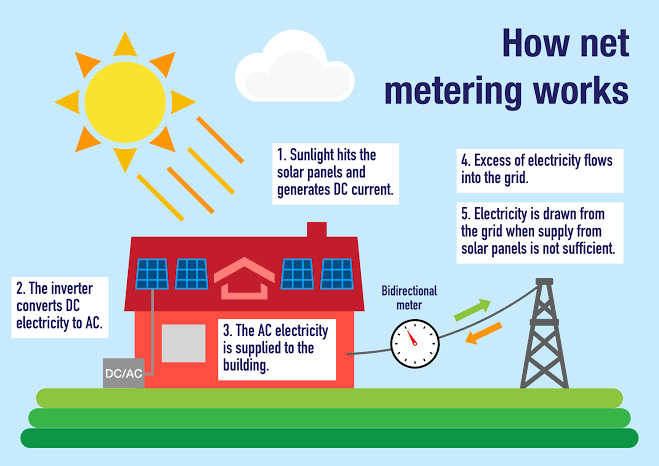
If you’re considering installing a rooftop solar system, you’ve probably heard the term net metering. While it may sound technical, the concept is actually quite simple. Net metering allows homeowners to make the most of the electricity their solar panels generate by sending excess power back to the grid and receiving credits in return, subject to applicable regulations.
Understanding how net metering works can help you maximize the value of your rooftop solar investment and reduce your electricity bills.
What Is Net Metering?
Net metering is a billing arrangement that allows households with rooftop solar systems to export surplus electricity to the electricity grid when they generate more power than they use.
When your home needs more electricity than your solar panels are producing—such as at night or on cloudy days—you draw power from the grid as usual.
Your electricity bill is then calculated based on the net electricity consumed, following your state’s net metering rules and your DISCOM’s regulations.
How Does Net Metering Work?
Here’s a simple example:
During the Day
- Your solar panels generate electricity.
- Your home uses a portion of that electricity.
- Any excess electricity is exported to the grid.
At Night or During Low Solar Generation
- Your home imports electricity from the grid.
- Depending on applicable net metering rules, the electricity exported earlier may offset some or all of the imported electricity.
This allows homeowners to make better use of the electricity their rooftop solar systems produce.
A Simple Example
Suppose your 3kW rooftop solar system generates 400 units of electricity in a month.
- Your household consumes 300 units directly.
- The remaining 100 units are exported to the grid.
Later, during nighttime or cloudy days, your home imports electricity from the grid.
Depending on your state’s net metering policy, those exported units may be credited against your imported electricity, reducing your monthly electricity bill.
What Is a Net Meter?
A net meter is a special electricity meter installed by your electricity distribution company (DISCOM).
Unlike a regular electricity meter, it records both:
- Electricity imported from the grid
- Electricity exported to the grid
This helps calculate your net electricity consumption for billing purposes.
Benefits of Net Metering
Net metering offers several advantages for homeowners:
- Lower monthly electricity bills
- Better utilization of rooftop solar generation
- Credits for surplus electricity (subject to regulations)
- Faster recovery of solar installation costs
- Reduced dependence on conventional electricity
- Encourages clean energy adoption
Do You Get Paid for Extra Electricity?
This depends on your state’s electricity regulations and your DISCOM’s billing policy.
In many cases, surplus electricity is adjusted as credits against future electricity consumption rather than being paid in cash. Some states have different settlement mechanisms, annual adjustments, or export compensation rules.
Always check the latest policy applicable in your area.
Is Net Metering Available Everywhere?
Net metering is available in many parts of India, but the rules vary from state to state.
The following may differ:
- Eligibility criteria
- Maximum system capacity
- Settlement period
- Export limits
- Billing methodology
- Applicable charges
Your local DISCOM can provide the latest information.
How to Apply for Net Metering
The process generally includes:
- Apply for rooftop solar through the official portal or your DISCOM.
- Receive technical approval.
- Install the solar system using an authorized or empanelled vendor (where required).
- Request inspection by the DISCOM.
- Install the net meter after approval.
- Begin exporting surplus electricity to the grid.
The exact process varies by state and electricity distribution company.
Does Net Metering Increase Solar Savings?
In many cases, yes.
Without net metering, excess electricity generated during the day may not provide the same financial benefit. Net metering allows eligible households to receive value for surplus electricity by offsetting future electricity consumption, improving the overall economics of rooftop solar.
Things to Keep in Mind
Before installing a rooftop solar system:
- Verify your state’s current net metering policy.
- Confirm your system size is eligible.
- Use a qualified installer.
- Understand your DISCOM’s billing process.
- Review annual settlement rules and applicable charges.
Staying informed helps you make better financial decisions.
Conclusion
Net metering is one of the key reasons rooftop solar has become financially attractive for homeowners. By allowing households to export unused solar electricity and receive credits under applicable regulations, it helps maximize the value of every unit of electricity generated. Although policies differ across states, understanding how net metering works can help families lower electricity bills, improve the return on their solar investment, and make the most of clean, renewable energy.
Frequently Asked Questions (FAQs)
1. What is net metering in simple terms?
Net metering is a billing system that allows homeowners with rooftop solar panels to send surplus electricity to the grid and receive credits that can offset future electricity consumption, subject to local regulations.
2. Do I get paid for the extra electricity my solar panels generate?
It depends on your state’s policy and your DISCOM. In many cases, surplus electricity is adjusted as bill credits rather than paid as cash.
3. Is a net meter different from a normal electricity meter?
Yes. A net meter records both the electricity you import from the grid and the electricity you export from your rooftop solar system.
4. Can I use electricity at night with net metering?
Yes. At night, when solar panels are not generating electricity, your home draws electricity from the grid. Depending on applicable rules, exported solar energy may offset some of this consumption.
5. Is net metering available in every state?
Many states offer net metering, but eligibility, billing methods, capacity limits, and settlement rules vary. Check with your local DISCOM for the latest guidelines.
6. Does net metering reduce my electricity bill?
Yes, in many cases. By receiving credits for surplus electricity exported to the grid, eligible households can reduce their net electricity charges.
7. Can I install rooftop solar without net metering?
Yes. However, without a net metering arrangement (or another approved export mechanism), you may not receive the same financial benefit for surplus electricity generated by your system.
8. How long does it take to get a net meter installed?
The timeline varies depending on your DISCOM, application process, inspection schedule, and state regulations.
9. Is net metering included in the PM Surya Ghar: Muft Bijli Yojana?
Eligible rooftop solar installations under the scheme typically require compliance with the applicable DISCOM procedures, which may include net metering or another approved metering arrangement based on local regulations.
10. Does net metering improve the return on investment (ROI) of rooftop solar?
For many homeowners, yes. Receiving credits for surplus electricity can increase overall savings and help shorten the payback period, depending on state policies and electricity usage.
Disclaimer: Net metering rules, billing mechanisms, export compensation, eligibility criteria, and settlement procedures vary by state and electricity distribution company (DISCOM). Always verify the latest regulations with your local DISCOM and refer to the official PM Surya Ghar portal before making decisions regarding rooftop solar installation.
Leave a Reply